

Car Battery Replacement: When to Act

That flat, sluggish start first thing in the morning is usually your car giving you fair warning. Car battery replacement often gets left until the vehicle will not start at all, but by then you are already dealing with the inconvenience of being stranded at home, at work or in a car park with a boot full of groceries.
A failing battery rarely dies without a few clues. The trick is knowing what matters, what can wait, and when the battery is not actually the main problem. For local drivers around Wallsend, Maryland and greater Newcastle, that matters even more when the car is relied on for work, school runs, weekend trips or towing.
Car battery replacement is not always just about age
Most batteries do not fail on a neat schedule. Plenty of drivers have heard that a battery should last three to five years, and that is a reasonable guide, but real life gets in the way. Short trips, stop-start driving, hot weather, long periods parked up and extra electrical load can all shorten battery life.
A car that only does quick runs to the shops may wear out a battery faster than one doing regular longer trips. The alternator needs enough driving time to recharge what was used during starting, and repeated short drives do not always give it that chance. On the other hand, a vehicle that sits unused for long stretches can also flatten and damage the battery.
That is why age matters, but testing matters more. If a battery is getting on in years and showing signs of weakness, replacement is usually the sensible move. If it is relatively new but the car still struggles to start, there may be a charging or parasitic drain issue that needs proper diagnosis.
Common signs you may need car battery replacement
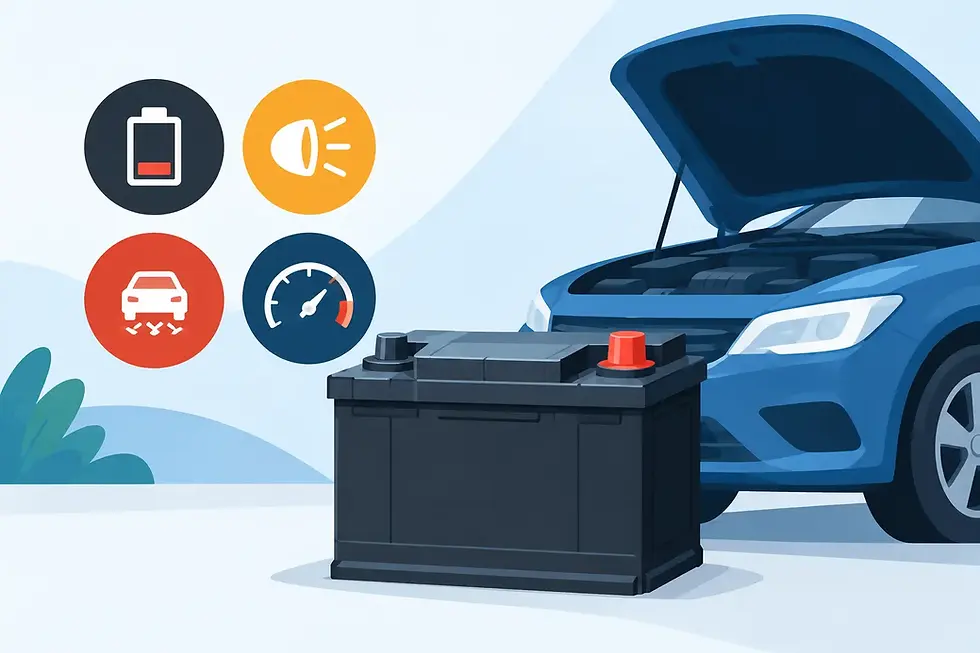
The most obvious sign is slow cranking. If the engine turns over more lazily than usual, especially on cold mornings, the battery may be losing capacity. You might also notice dash lights flickering during startup, interior lights dimming, or electrical accessories acting strangely.
Sometimes the warning is less direct. Start-stop systems may stop working properly. Power windows can seem slower. The vehicle may need a jump-start after being parked overnight or over a weekend. If that happens more than once, it is time to stop guessing.
Physical condition counts too. If the battery case is swollen, leaking or badly corroded around the terminals, replacement should not be put off. Corrosion can sometimes be cleaned, but if the battery itself is deteriorating, cleaning the terminals only treats part of the problem.
A battery warning light on the dash also deserves attention, but it does not automatically mean the battery itself has failed. It can point to the alternator, charging circuit or wiring. That is one reason proper testing is better than simply fitting a new battery and hoping for the best.
Why batteries fail earlier than expected
Heat is a big factor in NSW conditions. High temperatures can speed up internal battery wear, even if the failure does not show up until later. A battery might cope through summer, then give up when the weather changes or when the engine needs a stronger crank.
Driving habits also make a difference. Modern vehicles run plenty of electronics in the background, and that load does not disappear when the engine is off. Phone chargers, dash cams, interior lighting and aftermarket accessories can all contribute if the system is already marginal.
Then there is vehicle type. Some 4WDs and work vehicles live a harder life than the average commuter car. Corrugations, vibration, towing and accessory use all put extra strain on the battery and charging system. In those vehicles, choosing the right replacement battery is just as important as replacing it on time.
The right battery matters
Not all batteries are interchangeable. Size, terminal layout, cold cranking amps and reserve capacity all need to suit the vehicle. In some cases, especially with newer models, the battery type is critical. Start-stop vehicles may require an EFB or AGM battery rather than a standard flooded battery.
Fit the wrong one and you can end up with poor starting performance, charging issues or a battery that wears out far too soon. It can also affect the operation of onboard systems that are designed around a specific battery specification.
That is where workshop advice is worth having. A proper battery replacement should match the vehicle, the way it is used and the conditions it operates in. A family SUV doing school runs and Newcastle traffic needs something different from a 4WD set up for weekend trips and accessories.
Battery replacement or charging system fault?
This is where a lot of money gets wasted. If the battery is flat because the alternator is not charging properly, replacing the battery may get the car going again for a short time, but the problem will come straight back. The same applies if there is an electrical drain pulling power while the vehicle is parked.
A good battery test looks at more than voltage. It checks the battery's condition under load and considers how the charging system is performing. If the battery has failed, replacement is straightforward. If not, there is no point fitting parts the car does not need.
For drivers, the practical takeaway is simple. If the car has needed a jump-start, is hard to start, or the battery warning light is on, book it in before the issue gets worse. Waiting often turns a manageable workshop visit into a tow truck job.
How long does car battery replacement take?
On many vehicles, replacing a battery is quick. On others, it is not just a case of lifting out the old one and dropping in a new unit. Some batteries are tucked away under covers, in the boot, or in awkward engine bay positions. Newer vehicles may also require battery registration or system reset procedures after fitting.
That is another reason the job is not always ideal as a rushed DIY effort in the driveway. Incorrect installation can lead to electrical faults, warning lights or damage to sensitive systems. Even something as simple as losing radio settings is the best-case scenario. At the other end, you can create issues with vehicle electronics if the battery is not replaced correctly.
When proactive replacement makes sense
There is a difference between replacing a battery too early and replacing it before it lets you down. If your battery is several years old and you are already seeing slower starts, especially before a road trip or busy work period, proactive replacement can save a lot of hassle.
This is particularly true for households with one main vehicle, tradies who depend on their ute every day, and parents who do not have time for surprise breakdowns. The cost of a battery is usually minor compared with lost time, missed work or being stranded somewhere inconvenient.
If you are buying a used car, battery condition is also worth checking. A vehicle can look fine at inspection and still have a battery on borrowed time. It is not the biggest mechanical issue a used car can have, but it is one of the most common annoyances after purchase.
What to expect from a proper battery service
A proper battery job is more than swapping parts. The battery should be tested, the terminals checked, the hold-down secured properly and the charging system assessed if there are any doubts. If there is corrosion, it should be dealt with. If the replacement battery needs to meet a particular spec, that should be confirmed before fitting.
For local drivers who want it handled properly without dealership prices, that straightforward workshop approach matters. At Scott Forbes Automotive, the focus is on fitting the right battery, checking the system around it and giving practical advice if there is another issue in play.
A few habits that help batteries last longer
You cannot make a battery last forever, but you can avoid shortening its life. If you mostly do short trips, an occasional longer drive helps the charging system do its job. Leaving lights or accessories on with the engine off is an obvious one, but so is relying too heavily on add-ons that draw power when parked.
If the vehicle is not driven often, it is worth keeping an eye on battery condition before it gets to the point of no return. And if starting behaviour changes, do not ignore it for weeks hoping it sorts itself out. Batteries do not usually recover with age.
If your car is cranking slowly, needing jump-starts or showing signs the battery is on the way out, sort it before it turns into a bigger interruption than it needs to be.
Comments