
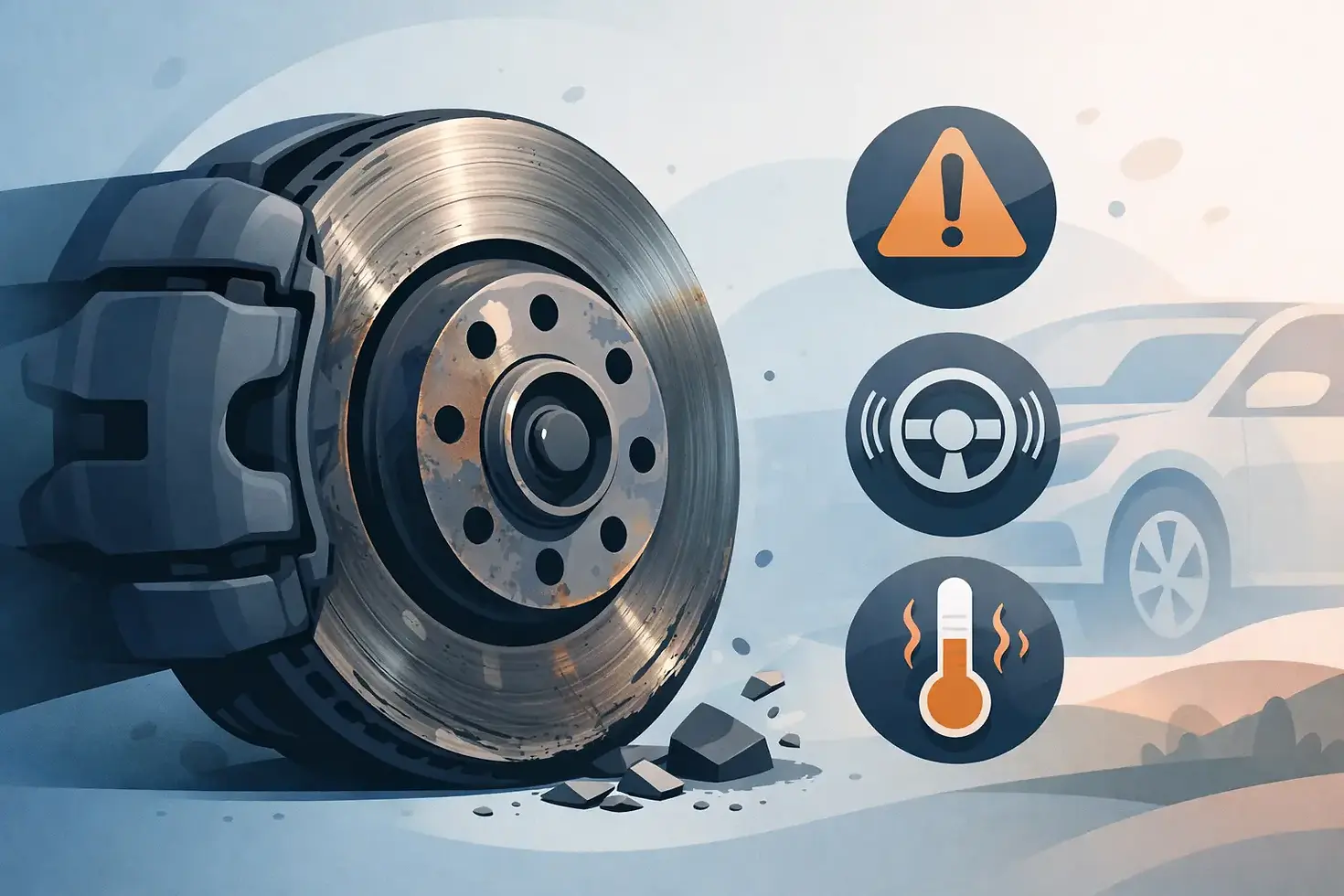
How to Know Brake Discs Worn Out
You usually notice brake disc wear when the car starts doing something it never used to do - a shudder through the pedal, a scraping sound when braking, or stopping that feels rough instead of smooth. If you’re wondering how to know brake discs worn enough to need attention, the short answer is this: changes in feel, noise and visible condition are the main warning signs, and they should not be ignored.
Brake discs cop a lot of heat and pressure every time you slow down. Over time they wear thinner, develop grooves, or become uneven from heat. Some wear is completely normal. The problem starts when that wear affects braking performance, damages the pads, or pushes the discs past the manufacturer’s minimum thickness.
How to know brake discs worn beyond normal use
A worn brake disc does not always fail all at once. More often, it gets worse gradually. That is why many drivers put up with the symptoms for too long, especially if the car still technically stops.
One of the clearest signs is vibration under braking. If the steering wheel shakes or the brake pedal pulses when you slow down, the discs may be uneven or heat affected. People often call this warped discs. In practice, the issue can also be disc thickness variation or uneven pad deposits. Either way, the braking surface is no longer smooth, and you will feel it.
Noise is another common clue. A light squeal can sometimes be just brake pad material or dust, but grinding or scraping needs checking straight away. If the pads are badly worn, metal can contact the disc and score it deeply. In that case, replacing pads alone is usually not enough.
You can also look through the wheel in some cases and inspect the disc surface. A healthy used disc will not look brand new, but it should still appear relatively even. Deep grooves, heavy lip edges, blue heat marks or obvious rough patches suggest the disc has had a hard life.
Stopping performance matters too. If the car takes longer to pull up, feels less confident under brakes, or seems to grab unevenly, worn discs may be part of the problem. That said, braking issues can also come from pads, calipers, brake fluid or tyres. Proper inspection matters because the symptom does not always point to one part only.
The main signs your brake discs are worn
Most drivers do not measure brake disc thickness at home, so the practical signs are what matter first. If you notice any of these, it is worth getting the brakes checked.
Vibration when braking
This is one of the most common complaints. You might feel it through the brake pedal, steering wheel or even the whole vehicle at higher speeds. It often shows up when braking from 80 km/h or above, but on more severe cases it can happen at suburban speeds too.
Scoring and grooves
If the disc surface has visible circular grooves, it means the pads and disc have been wearing against each other unevenly. Light marking can be normal. Deep scoring is not. It reduces effective braking contact and usually means the disc surface is too damaged to leave alone.
A pronounced lip on the disc edge
As the braking surface wears down, the outer edge can form a lip. A small lip is common on older discs, but if it is obvious to the eye or touch, the disc may be close to or under minimum thickness.
Scraping or grinding noises
This can mean severe pad wear, disc damage, or both. If you hear grinding, do not keep driving on it for weeks hoping it goes away. That usually turns a simpler brake job into a more expensive one.
Blue spots or heat marks
Brake discs get hot, but repeated overheating leaves visible marks. Blue or dark heat patches can mean the disc has been under excessive stress. That can affect the metal and lead to uneven braking.
Cracks on the disc surface
Fine heat cracks are more common on heavily worked vehicles, performance cars and some 4WD applications. Any visible cracking should be inspected promptly. Cracked discs are not something to take chances with.
Why brake discs wear out
Brake discs are wear items, but some vehicles go through them faster than others. Stop-start commuting around Newcastle suburbs, towing, hilly driving, carrying loads in a 4WD, and repeated hard braking all increase wear.
Pad quality also plays a part. Some compounds are tougher on discs than others. Cheap parts can save money up front but create more noise, dust or uneven wear later. Driving style matters too. Smooth braking generally helps components last longer than repeated heavy braking right at the last second.
Sometimes the problem is not the disc alone. A sticking caliper can keep pressure on one pad, overheating one side and wearing the disc unevenly. That is why a proper brake inspection should look at the full system, not just the obvious surface marks.
Can you tell if brake discs are worn without removing the wheel?
Sometimes yes, but not always accurately. On many cars you can see enough through the wheel to spot heavy scoring, rust build-up, heat marks or a large lip. That gives you a rough idea, not a final answer.
The real check is measuring disc thickness and inspecting the pads, calipers and braking surfaces properly. Every disc has a minimum thickness specification. Once it wears below that limit, it should be replaced. Machining is only an option if there is enough material left afterwards. On many modern vehicles, replacement is the more practical and safer fix.
How to know brake discs worn versus just brake pads
The symptoms can overlap, which is where people get caught out. Worn pads often cause squealing, reduced braking performance or a warning light if the vehicle has a wear sensor. Worn discs are more likely to cause vibration, visible grooves and rough braking feel. But in the real world, pads and discs often wear together.
If pads have been run too low, they can damage the disc surface. If a disc is badly worn or uneven, a fresh set of pads may not bed in properly. That is why many brake jobs involve replacing both pads and discs at the same time. It is not about upselling. It is about making sure the new parts work properly together.
When to repair, machine or replace
This depends on disc thickness, surface condition and the type of damage.
If the disc is still above minimum thickness and has only minor irregularities, machining may be possible. That said, not every disc is worth machining. Some are already too close to the limit, and some modern replacements are cost-effective enough that fitting new discs makes more sense.
If the disc is deeply scored, heat damaged, cracked or below specification, replacement is the correct repair. There is no safe shortcut around that. Brakes are one area where trying to squeeze every last kilometre out of a part can cost more later.
Don’t wait for the obvious signs
A lot of brake disc wear is picked up during routine servicing before the driver notices anything dramatic. That is the best-case scenario. It means you can plan the repair before it turns into metal-on-metal damage or unsafe stopping.
If your car has started vibrating when braking, making scraping noises, or showing visible disc wear through the wheel, it is worth getting it checked sooner rather than later. For local drivers, a workshop like Scott Forbes Automotive can inspect the full brake system, measure disc thickness properly and tell you plainly whether the discs are still serviceable or due for replacement.
There is no prize for stretching worn brakes a bit longer. If something feels off when you slow down, trust it and get it looked at before it becomes a bigger job.


Comments