

Why Does My Car Keep Overheating?
You are sitting at the lights in Wallsend, the temperature gauge starts climbing, and suddenly you are asking the question every driver dreads - why does my car keep overheating? It might happen in traffic, on the school run, towing a trailer, or heading up the road on a hot Newcastle day. Whatever the situation, repeated overheating is not something to push through and hope for the best.
An overheating engine can go from a minor repair to a major one very quickly. A split hose or weak radiator cap is usually manageable. Keep driving with the gauge in the red, and you can end up with a blown head gasket, warped cylinder head or full engine damage. That is why the real issue is not just getting the temperature down once. It is finding out why it keeps happening.
Why does my car keep overheating while driving or idling?
The answer is usually a fault somewhere in the cooling system, but not always the same fault. Some cars overheat only in stop-start traffic. Others run hot at highway speed, under load, or when the air conditioner is on. That pattern matters because it helps narrow down the cause.
If a car overheats at idle but cools down once you are moving, the radiator fan or fan control system is often suspect. If it overheats more at speed, you could be dealing with poor coolant flow, a blocked radiator, or combustion gases entering the cooling system. If it only happens on steep climbs or when towing, the system may be coping most of the time but failing under extra demand.
That is why proper diagnosis matters. Replacing parts based on guesswork can get expensive fast and still not fix the problem.
The most common reasons a car overheats
Low coolant level
This is one of the most common causes, but low coolant is usually a symptom as much as a fault. Coolant does not normally just disappear. If the level keeps dropping, there is often a leak from a hose, radiator, water pump, thermostat housing, heater hose or expansion tank.
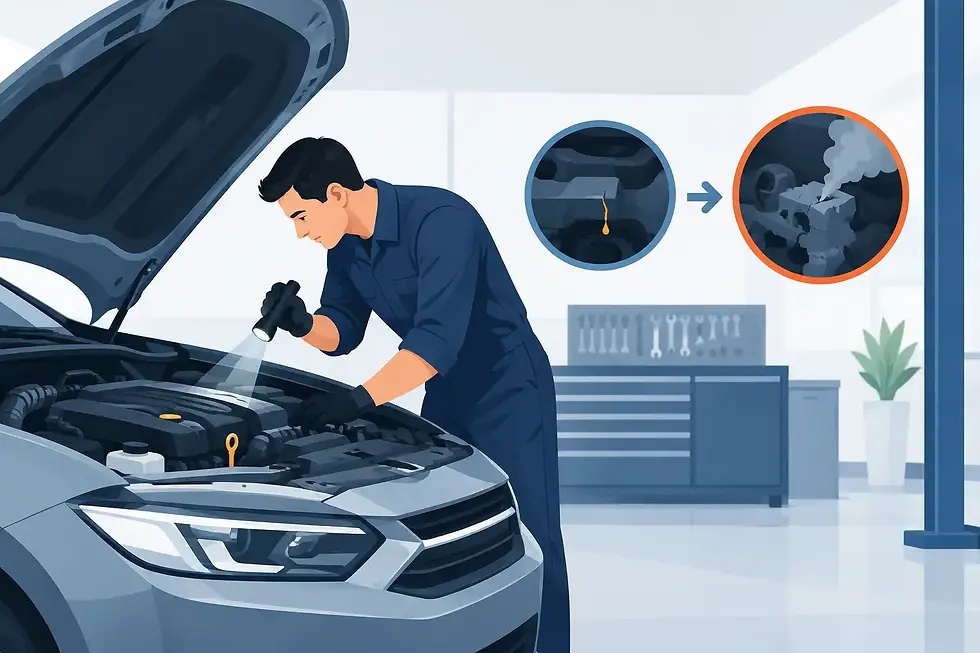
Some leaks are obvious, with coolant dripping onto the ground or leaving a white or coloured residue around fittings. Others are smaller and only show up when the engine is hot and the system is under pressure. In some cases, coolant may be leaking internally, which is more serious.
Coolant leak under pressure
A cooling system can seem fine when the engine is cold, then leak badly once it reaches operating temperature. Rubber hoses expand, plastic radiator tanks crack, clamps loosen over time, and seals fail. A proper pressure test is often the quickest way to find what is going on.
A small leak can still cause repeated overheating because the system cannot maintain the correct coolant level or pressure. That means less heat transfer and a lower boiling point.
Faulty thermostat
The thermostat controls coolant flow through the engine and radiator. If it sticks closed, coolant cannot circulate properly and the engine heats up fast. Sometimes it fails completely. Sometimes it sticks intermittently, which can make the overheating seem random.
This is one of those faults that sounds minor but can cause major trouble if ignored. A thermostat is a relatively small part, but it plays a big role in keeping engine temperature stable.
Water pump problems
The water pump moves coolant through the system. If the pump is worn, leaking, noisy, or the impeller is damaged, coolant flow can be reduced or lost. Some pumps fail gradually, which means the car may only overheat in certain conditions before the problem becomes constant.
On some vehicles, water pump issues can be tied to the timing belt or related components. That is another reason not to leave cooling system work too long.
Blocked or restricted radiator
Radiators can become blocked internally from old coolant, corrosion or contamination. They can also be blocked externally by dirt, debris and bent fins, reducing airflow. In either case, the radiator cannot shed heat properly.
This often shows up in older vehicles, neglected vehicles, or cars that have had the wrong coolant used. A radiator may still look serviceable from the outside and still be part of the problem.
Radiator fan not working
If your car overheats in traffic but seems better once you are moving, the radiator fan should be checked. Modern vehicles rely on electric fans to pull air through the radiator at low speed and idle. If the fan motor, relay, fuse, wiring or temperature sensor has failed, the engine can quickly run hot in stop-start conditions.
Air conditioning can make this more noticeable because it adds heat load and often relies on proper fan operation as well.
Failed radiator cap
The radiator cap helps maintain system pressure. That pressure raises the boiling point of the coolant. If the cap is weak or faulty, coolant may boil earlier than it should, and the system may lose coolant into the overflow bottle or out of the system.
It is a small part that is easy to overlook, but it can absolutely contribute to overheating.
Head gasket or internal engine fault
This is the one most drivers worry about, and for good reason. A blown head gasket can push combustion gases into the cooling system, force coolant out, create overheating, and cause ongoing pressure issues. It may also let coolant into the engine or oil into the coolant.
Typical signs include unexplained coolant loss, overheating that keeps returning after top-ups, white exhaust smoke, contaminated oil, bubbling in the radiator or overflow bottle, or hard cooling system hoses soon after start-up. Not every overheating car has a head gasket problem, but once those signs appear, it needs to be checked properly.
Signs you should not ignore
If your temperature gauge is creeping higher than normal, the heater stops blowing properly hot air, you smell coolant, or you notice steam from under the bonnet, do not keep driving as if it will sort itself out. The same goes for repeated coolant top-ups, wet patches under the car, or warning lights coming on.
One overheating event is bad enough. A pattern of overheating means there is an unresolved issue. Even if the car seems to settle down after cooling off, the damage risk is still there.
What to do when your car starts overheating
The safest move is to turn the air conditioner off, put the heater on full if you need to reduce heat in the short term, and pull over somewhere safe as soon as possible. Switch the engine off and let it cool down. Do not remove the radiator cap while the system is hot.
If you keep driving with the gauge in the red, you are gambling with the engine. Plenty of expensive repairs start with a driver trying to make it just a few more kilometres.
Once the engine is cool, you can check the coolant level if it is safe to do so, but that does not replace proper inspection. Topping it up might get the level back temporarily. It does not tell you why the coolant is low or why the car overheated in the first place.
Why overheating keeps coming back after a quick fix
This is where a lot of people get caught out. They top up the coolant, replace one hose, or fit a thermostat, and the problem seems gone for a week or two. Then it happens again.
The reason is simple. Overheating often has more than one contributing fault, or the obvious symptom gets fixed while the actual cause stays in the system. A leak may have caused air pockets. A blocked radiator may have damaged the thermostat. A head gasket issue may only show up once the engine is under load. Without testing the full system, it is easy to miss the bigger picture.
Why proper diagnosis matters
If you are wondering why does my car keep overheating, the right answer usually comes from testing, not guessing. A proper cooling system inspection can include checking for leaks, pressure testing, confirming fan operation, assessing thermostat function, looking at radiator condition, checking water pump performance and testing for combustion gases where needed.
That approach saves time and often saves money because you are fixing the actual fault rather than replacing parts one by one. For local drivers around Wallsend, Maryland and Newcastle, this is the sort of issue worth getting looked at early before it turns into engine damage and a much larger bill.
At Scott Forbes Automotive, cooling system faults are diagnosed the practical way - with experience, proper testing and straightforward advice about what needs doing now and what can wait.
Don’t wait for the next hot day
A car that keeps overheating is already giving you a warning. Whether it is a minor leak, failed fan, blocked radiator or something more serious, the cheapest time to deal with it is usually before the next breakdown. If your gauge has been climbing, your coolant keeps dropping, or the engine has run hot more than once, get it checked before a manageable repair becomes an engine problem.
Comments