
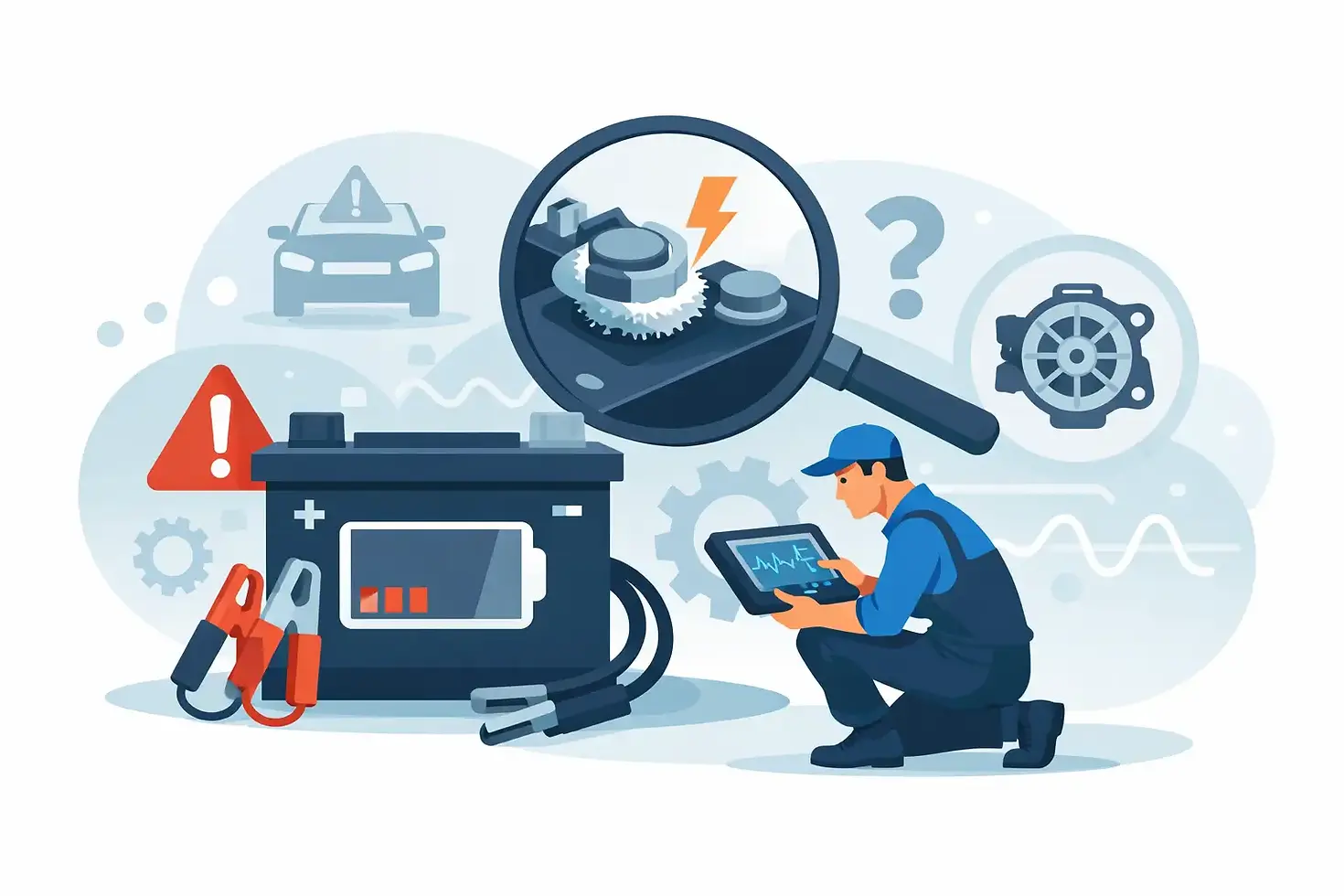
Flat Battery Diagnosis: Find the Real Cause

A car that will not start before work is frustrating. Replacing the battery might get you moving, but it does not always fix the reason it went flat. A proper flat battery diagnosis checks whether the battery has reached the end of its life, the alternator is not charging properly, or something is draining power while the vehicle is parked.
For drivers around Wallsend, Maryland and Newcastle, the difference matters. A battery can fail without much warning, but repeat flat batteries often point to a fault elsewhere. Finding that fault early can prevent a roadside no-start, an unnecessary battery purchase and damage caused by low system voltage.
What a flat battery diagnosis actually checks
A battery is only one part of the starting and charging system. The battery supplies the high current needed to crank the engine, the alternator restores that charge once the engine is running, and the vehicle's wiring and electronic modules use a small amount of power when parked. A fault in any of these areas can leave you with a flat battery.
At the workshop, diagnosis starts with the basics: checking the battery terminals, cables, earth connections and battery condition. Loose, corroded or damaged connections can restrict current flow and create the same symptoms as a weak battery. The battery then needs to be tested properly, not judged only by whether dash lights come on.
A full check may include battery voltage and state of charge, cold cranking performance, alternator charging voltage and output, starter draw, and a parasitic draw test where needed. The exact process depends on the vehicle and its symptoms. A car that goes flat overnight is investigated differently from one that only struggles to start on cold mornings.
Signs the problem may be more than an old battery
Most batteries give some warning before they fail completely. Slow or laboured cranking is common, particularly after the car has sat overnight. You may also notice headlights dimming at idle, the start-stop system no longer operating, intermittent warning lights, or the clock and radio resetting after startup.
These symptoms are worth checking soon, but they do not automatically mean the battery is faulty. A poor terminal connection can cause slow cranking. A worn starter motor can draw excessive current. An alternator that is undercharging may leave the battery partly discharged every time you drive.
If the car starts after a jump-start but goes flat again soon after, do not assume it simply needs more driving. The battery may be unable to hold charge, or the charging system may not be replacing the energy used to start the engine. Continuing to jump-start the vehicle can mask the issue and, in some cases, create further electrical problems.
Age, driving habits and heat all affect battery life
In normal conditions, many car batteries last around three to five years, though there is no fixed expiry date. Newcastle heat, short trips and frequent stop-start use can shorten that lifespan. Short drives are particularly hard on a battery because the engine may not run long enough for the alternator to recover the power used during starting.
Vehicles with plenty of accessories also place higher demands on their electrical systems. Dash cameras, auxiliary lighting, fridges in 4WDs, aftermarket stereos and mobile chargers can be perfectly safe when installed correctly, but they need to be considered if a battery is repeatedly going flat.
Battery test versus charging system test
A voltage reading alone tells only part of the story. A fully charged 12-volt battery at rest may show a healthy voltage yet still collapse under the load of starting the engine. That is why a load or conductance test is useful. It checks the battery's ability to deliver current, not just the charge sitting on its surface.
The alternator also needs testing under realistic conditions. With the engine running, it should provide enough charge for the battery while supporting lights, air conditioning, demister and other electrical loads. An alternator may appear acceptable with no accessories on, then fall short once the vehicle is being used normally.
Overcharging is another possibility. Excessive charging voltage can damage a battery, shorten its life and affect sensitive electronics. The correct repair is not always a replacement alternator either. Depending on the vehicle, the cause could be a regulator, wiring fault, poor earth or battery management sensor.
Modern vehicles are more sensitive to battery condition than older cars. Low voltage can trigger warning messages for unrelated systems because control modules need stable power to communicate. Replacing a weak battery may be part of the repair, but clearing a warning light without identifying the underlying voltage issue is not a reliable fix.
Finding an electrical drain when the car is parked
A small amount of battery draw after the vehicle is locked is normal. Security systems, clocks, engine computers and keyless-entry functions remain on in the background. Most modern vehicles also take time to enter sleep mode after the ignition is switched off.
A parasitic draw becomes a problem when a circuit continues using too much power after the vehicle should be asleep. This can flatten a healthy battery overnight or over several days. Common causes include a glovebox, boot or interior light staying on, a faulty relay, an aftermarket accessory, a module that does not shut down, or damaged wiring.
Testing for a drain requires patience and the right equipment. The vehicle must be allowed to power down correctly, then current draw is measured and circuits are isolated methodically. Pulling fuses at random can wake modules and change the readings, which is why this job is best handled as a diagnostic process rather than a quick guess.
If the problem only happens occasionally, give the mechanic as much information as possible. Note how long the car was parked, whether it was locked, any accessories left connected, recent repairs or installations, and whether warning lights appeared before the battery went flat. A clear history can save diagnostic time.
What to do when your battery goes flat
If you need to jump-start the vehicle, follow the owner's handbook and use suitable jump leads or a jump pack. Keep sparks away from the battery, connect the leads in the correct order and do not attempt a jump-start if the battery is cracked, leaking, swollen or frozen. A damaged battery should be replaced safely.
Once the engine starts, avoid treating a long drive as a guaranteed repair. It may put enough charge back into the battery for the next start, but it cannot restore a battery with failed internal cells or repair an alternator fault. Arrange a battery and charging-system check as soon as practical, especially if the car has gone flat more than once.
Do not disconnect the battery on a late-model vehicle just to reset warnings unless you know the correct procedure. You may lose radio settings, window calibrations and other stored information. Some vehicles also need battery registration or coding when a replacement is fitted so the charging system can manage it correctly.
A note for hybrids and EVs
Hybrid and electric vehicles still have a 12-volt battery for control systems, locks, lights and starting the high-voltage system. When that small battery is flat, the vehicle may not wake up or select drive, even though the main traction battery has charge remaining.
The diagnosis must be carried out with the vehicle's high-voltage safety procedures in mind. Do not touch orange high-voltage cables or attempt repairs outside the standard 12-volt system. A qualified technician can test the 12-volt battery, charging operation and related fault codes safely.
When replacement is the right answer
If testing confirms the battery has poor cranking capacity, cannot hold charge or is at the end of its service life, replacement is sensible. The replacement battery needs to match the vehicle's required size, terminal layout, capacity and technology. Many vehicles with start-stop systems require an AGM or EFB battery, and fitting a cheaper conventional battery can lead to reduced performance and early failure.
At Scott Forbes Automotive, the aim is straightforward: test the system, explain what has failed and recommend the repair that makes sense for your vehicle. Sometimes that is a new battery. Other times it is a charging repair, cable repair or further electrical investigation.
A flat battery is rarely convenient, but it does not have to become a recurring problem. If your car is cranking slowly, losing charge after sitting parked or needing regular jump-starts, book a diagnosis before the next no-start catches you at the worst possible time.


Comments