
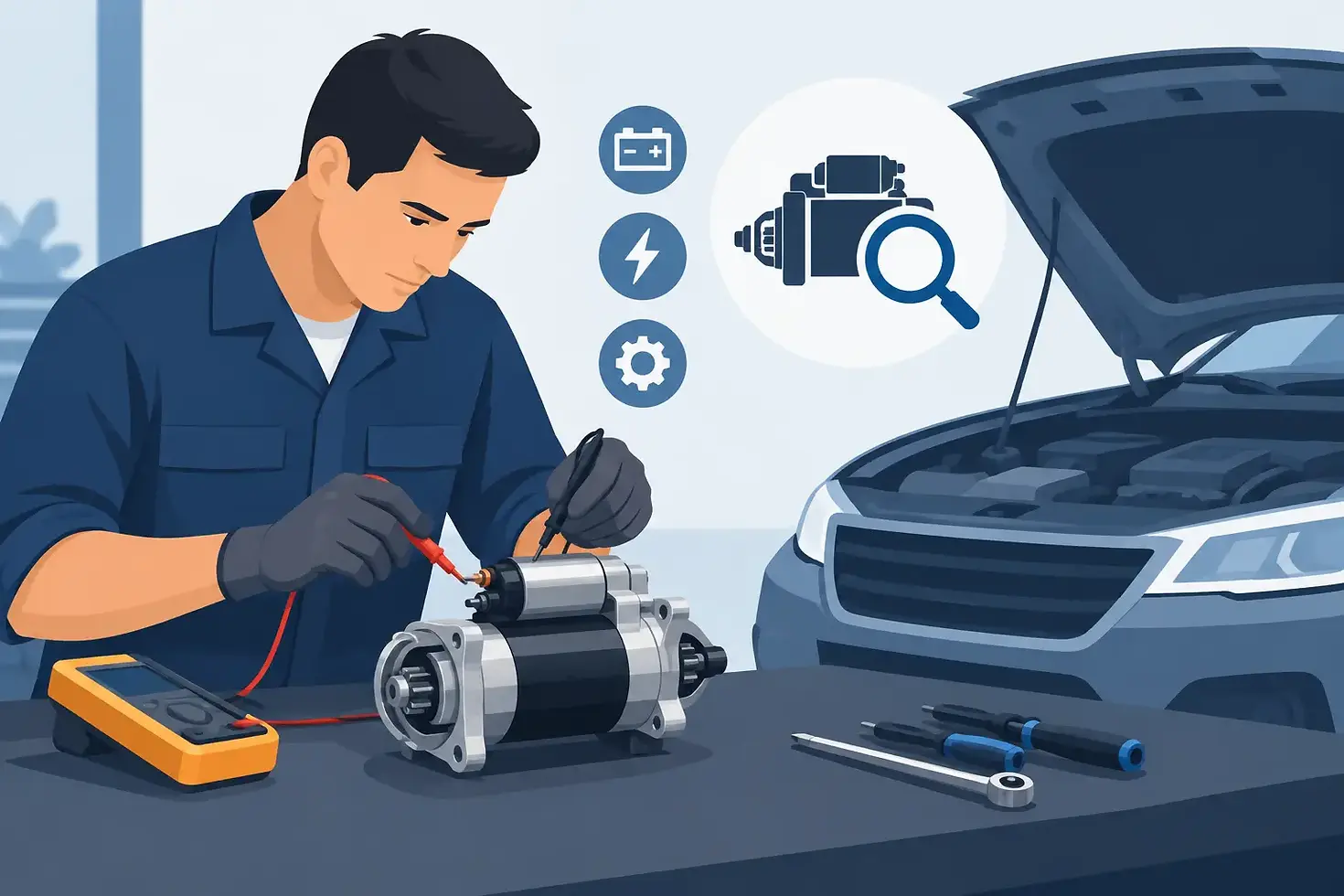
Starter Motor Diagnosis for No-Start Problems

A vehicle that will not start can quickly throw off the morning school run, work commute or weekend plans. Proper starter motor diagnosis is the difference between replacing parts on a guess and finding the actual fault - whether it is the battery, starter circuit, starter motor or something preventing the engine from turning.
The starter motor has one simple but demanding job: it must turn the engine fast enough for it to fire. When that does not happen, the symptoms can sound obvious, but they are not always pointing to the starter itself. A single click, a slow crank or complete silence can each have several possible causes.
What happens when you turn the key or press start?
The sound and behaviour of the vehicle give a mechanic a useful starting point. They do not provide a final answer on their own, particularly in modern cars with push-button starting, immobilisers and multiple electronic control systems.
If the engine cranks strongly but does not start, the starter motor is generally doing its job. The fault may instead involve fuel delivery, ignition, engine sensors or, in some cases, a security system issue. This is a no-start condition, but not normally a starter motor failure.
If the engine turns over slowly, the first concern is often battery condition and battery cable connections. A battery can show enough power for dash lights and accessories while still lacking the current needed to crank an engine. Corroded terminals, loose clamps and poor earth connections can cause much the same symptom.
A rapid clicking sound commonly indicates insufficient current reaching the starter. One solid click may mean the starter solenoid is operating but the motor is not turning, although a weak battery or poor cable connection still needs to be ruled out before condemning the starter.
Complete silence is a different type of clue. It can be caused by a flat battery, a faulty starter relay, an ignition switch fault, a failed neutral or clutch safety switch, an immobiliser issue, damaged wiring or a faulty starter motor. This is why replacing the starter based on the noise alone can be an expensive mistake.
Starter motor diagnosis starts with the battery
A battery test is not just a quick voltage reading. A healthy-looking voltage with no load does not guarantee the battery can supply enough power under cranking demand. A workshop will check battery condition, available cold-cranking performance and voltage drop while attempting to start the vehicle.
Battery terminals and cables matter just as much. White or green corrosion around the terminals, a loose connection or a damaged cable can restrict current flow. The starter motor needs high current, so even resistance that seems minor can leave it unable to crank properly.
The earth path is equally important. The battery is connected to the engine and body through earth leads. If an earth strap is loose, corroded or damaged, current may not return properly to the battery. Sometimes the result is an intermittent no-start, which is frustrating because the car may start normally when it reaches the workshop.
Battery age is another factor. Many batteries last several years, but heat, short trips, a vehicle sitting unused and charging faults all reduce their service life. If a battery is failing, fitting a new starter motor will not fix the problem for long.
Warning lights and accessory behaviour
Dim headlights, a clock resetting, flickering dash lights or a slow electric window can support the case for a weak battery or poor connection. However, normal lights do not clear the battery completely. Headlights draw far less current than a starter motor, which is why proper load testing is worthwhile.
Testing the starter circuit
Once the battery, terminals and earths have been checked, the next step is confirming whether the starter is receiving the correct power and control signal. This is where a methodical starter motor diagnosis prevents unnecessary parts replacement.
A qualified mechanic may test the main power feed at the starter, the solenoid trigger wire, starter relay operation and voltage drop across the positive and earth sides of the circuit. A voltage-drop test is particularly useful because it identifies resistance under load, rather than simply confirming a wire has continuity when no real current is flowing.
Automatic vehicles also rely on a park or neutral safety system. If the vehicle does not recognise that it is in Park or Neutral, it may block the starter circuit. Manual vehicles commonly use a clutch pedal switch for the same safety reason. A fault in either switch can leave the vehicle completely silent when the key is turned.
Modern vehicles add other variables. Smart keys, immobilisers, body control modules and engine control units can all influence starting permission. A scan tool can identify relevant fault codes or data issues, but codes are only one part of the process. The wiring, battery supply and actual vehicle behaviour still need to be tested.
When the starter motor is the problem
A starter motor is an electric motor with a solenoid and drive gear. Over time, its internal brushes, bearings, contacts or windings can wear. The solenoid can also fail to engage reliably. Heat from the engine bay and repeated short trips can make an ageing unit more prone to intermittent faults.
Common starter motor signs include a single solid click with no crank after battery and cable faults have been eliminated, slow cranking despite good battery performance, or an intermittent start that improves after several attempts. In some cases, the starter may engage but make a grinding noise. That needs prompt attention, as damaged teeth on the starter drive or flywheel ring gear can make repairs more involved.
There is no benefit in continuing to hold the key in the start position when the engine will not crank. Repeated attempts can overheat cables and the starter, flatten the battery and complicate diagnosis. If the vehicle starts after a few tries, do not assume the issue has disappeared. Intermittent faults tend to become permanent at the least convenient time.
Faults that can look like a starter failure
Not every crank problem is electrical. An engine that is mechanically seized, hydrolocked or suffering a serious internal fault cannot be turned by the starter. In these cases, forcing the issue may damage the starter or wiring.
A manual vehicle can also create confusion if the clutch switch is not being activated properly. For automatics, try starting in Neutral only if it is safe to do so, the handbrake is firmly applied and the vehicle is stationary. If it starts in Neutral but not Park, the selector or safety switch needs checking.
Aftermarket accessories can be another consideration. Alarm systems, remote start equipment, auxiliary batteries and non-standard wiring may interfere with the starter circuit if they have developed a fault or were not installed correctly. This does not mean accessories are always the cause, but they should be considered during testing.
What you can check safely before booking in
There are a few sensible checks for drivers, without bypassing safety systems or working around high-current wiring. Check that the battery terminals are secure and not heavily corroded. Confirm the vehicle is in Park or Neutral, or fully depress the clutch in a manual. Try your spare key if an immobiliser or key battery warning has appeared.
Look for obvious clues such as warning lights, a battery light that came on while driving, a burning smell, damaged battery cables or oil leaks around the starter area. Avoid tapping the starter with tools, jump-wiring terminals or repeatedly jump-starting the car. Those shortcuts can cause damage, create a safety risk and hide the original issue.
If the car needs a jump-start, treat it as a clue rather than a repair. It may indicate a discharged or failing battery, but the charging system and battery condition should still be checked. A vehicle that has needed more than one jump-start needs attention before it leaves you stranded.
Repair or replace?
The right repair depends on test results, vehicle access, parts availability and the condition of the existing unit. Sometimes the issue is a terminal, cable, relay or battery, which is generally less costly than starter replacement. If the starter motor has failed internally, replacement is usually the practical option.
Quality matters with starter motors. Cheap units can have inconsistent fitment or service life, particularly on vehicles where access requires significant labour. A workshop should explain what has failed, what testing supports the recommendation and the expected cost before work proceeds.
At Scott Forbes Automotive, the focus is on finding the cause first and giving practical advice on the repair. For drivers around Wallsend, Maryland and Newcastle, that means clear testing, fair pricing and no guesswork when a no-start problem turns up.
If your vehicle is clicking, cranking slowly or refusing to start, organise an inspection before the fault becomes a tow-truck job. A timely diagnosis can often turn an uncertain morning into a straightforward repair.


Comments